
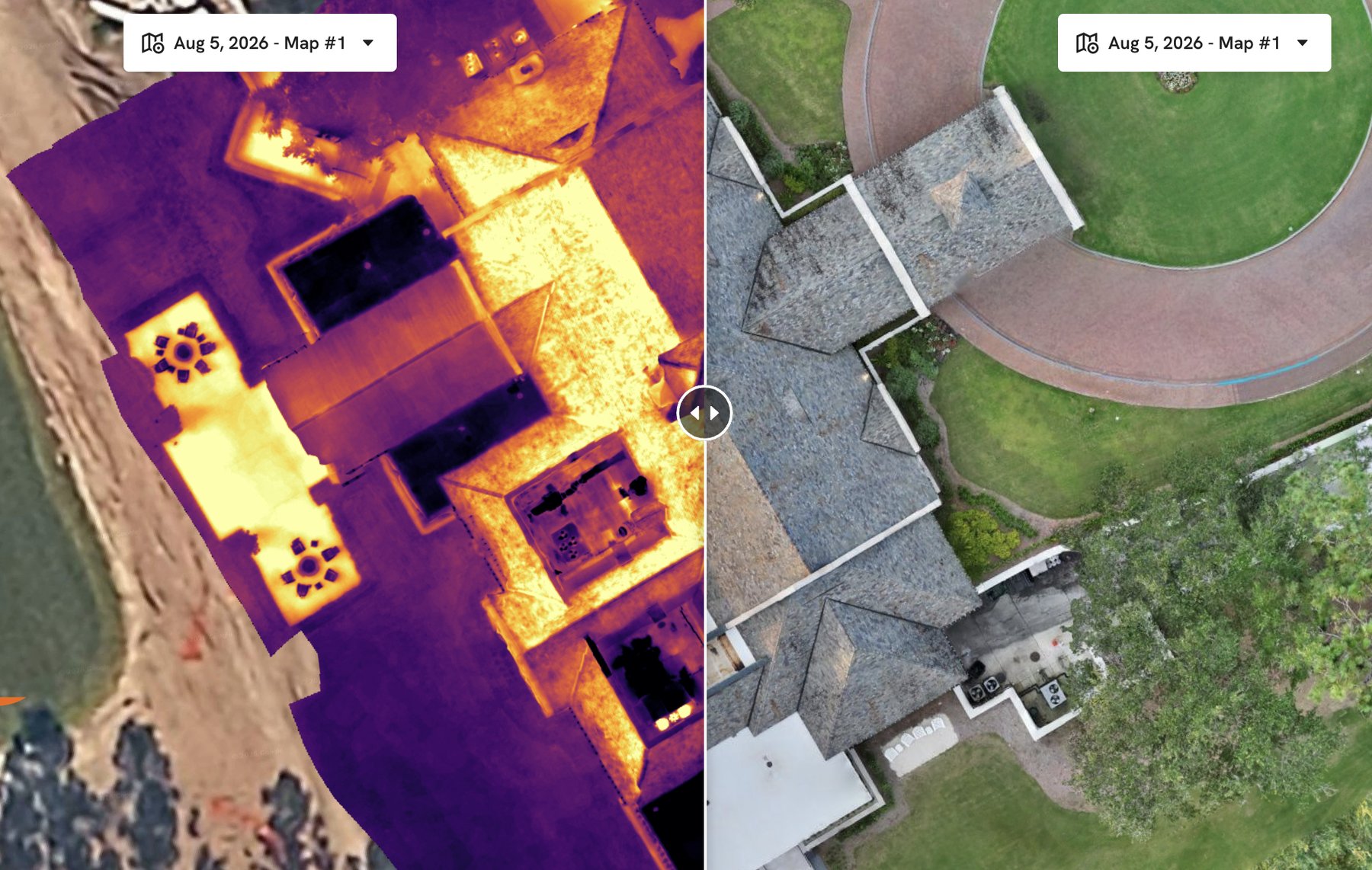
A roof walkthrough gives you an impression. It rarely gives you a record. On a recent mission over a commercial low-slope roof on the First Coast, we flew two passes over the same building — one visual, one radiometric thermal — and processed each into a georeferenced orthomosaic. Laid over one another, they show exactly why aerial thermal has become the baseline for serious roof assessment, and why a clipboard and an infrared spot gun leave money on the table.
Where the walkthrough runs out
A person on a roof can see standing water, blistered membrane, and a failed seam if they happen to be standing on it. What they can’t see is subsurface moisture — water tracking under the membrane, away from the entry point, into insulation that still looks fine from above. A handheld IR gun reads one spot at a time and reports a number with no location attached. Walk the same roof twice and you’ll cover it differently each time. None of it produces a document you can hand to an engineer, an adjuster, or a board.
That’s the gap. Not accuracy of the eye — accuracy of the record.
What we actually flew
The mission was a single sortie with two sensor passes. A high-overlap RGB pass built the visual orthomosaic; a radiometric thermal pass built the heat map. Both were flown under FAA Part 107, with flight lines planned so the two datasets could be co-registered into one coordinate space during processing.
Timing is most of the work in thermography, and it’s the part cheap inspections skip. Infrared moisture assessment under ASTM C1153-23 depends on capturing the roof during the window when it’s shedding stored heat — wet areas hold heat and lag behind dry ones, and that lag is the whole signal. Fly at the wrong hour and you get a heat map that looks authoritative and tells you nothing. We brief the window before we brief the flight.
Reading the thermal orthomosaic
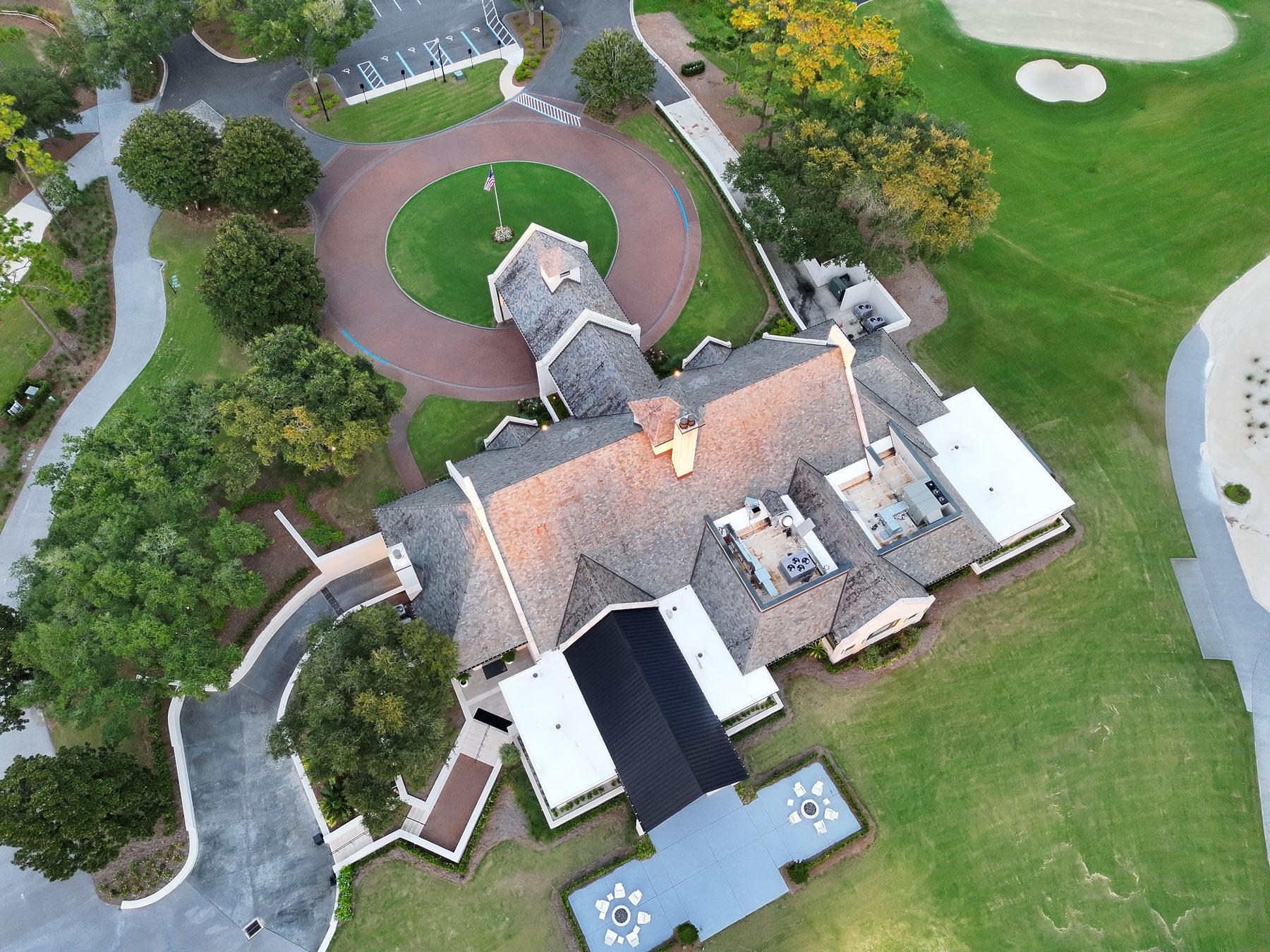
On the visual layer, the roof reads as uniform. That’s the trap: membrane problems and trapped moisture rarely announce themselves in daylight RGB. On the thermal orthomosaic, the same surface resolves into temperature differentials — cooler and warmer zones mapped across the entire roof at once, not sampled point by point.
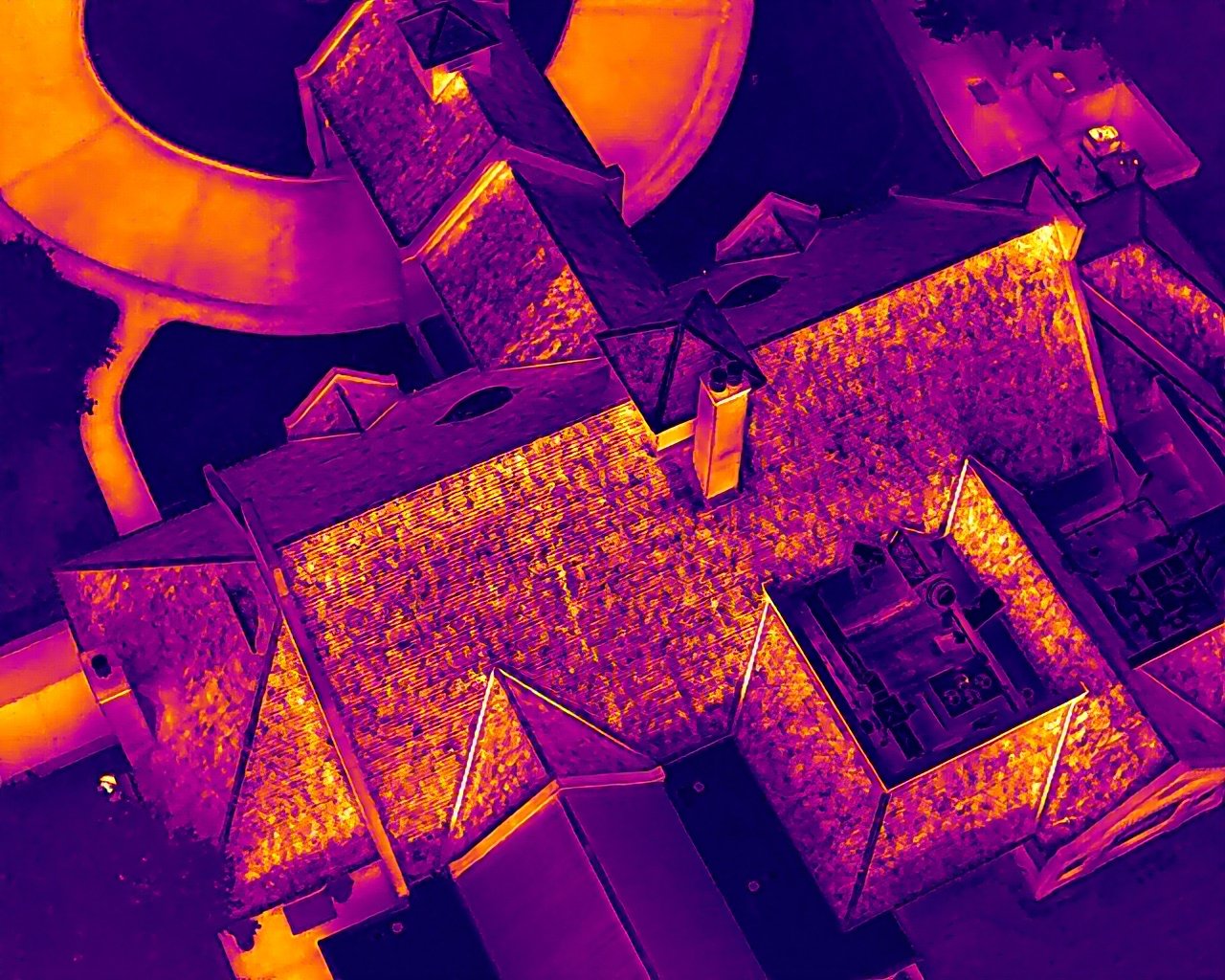
Because the thermal map is georeferenced, every differential sits at a known coordinate on the roof plan. You’re no longer gesturing at a region and calling it “somewhere near the third unit.” You can measure the area of an anomaly and give a facilities crew a location they can walk straight to and cut open. The side-by-side overlay is where it lands for an owner: the visual layer supplies the context — drains, penetrations, seams, units — and the thermal layer shows where the roof is behaving differently than it should.
Why georeferencing is the whole game
Any drone can shoot thermal stills. What separates a deliverable from a slideshow is positional control. We process to ASPRS 2024 Class II accuracy using RTK correction, with ground checkpoints flown to verify the solution rather than assume it. That means the orthomosaic carries a stated accuracy class instead of a vague promise that the map is “accurate.”
The practical payoff: a coordinate you can return to on the next inspection cycle and compare against, a map that ties cleanly to the building’s own roof plan, and an exhibit that holds up when someone downstream has a reason to challenge it. A finding is only as strong as the record behind it.
The deliverable, and why the record matters
Every CT Aero mission ships with the standards it was produced under — ASTM C1153-23 for the thermal methodology, ASPRS 2024 Class II for positional accuracy, Part 107 for the operation — and full chain of custody on the raw captures, the processed orthomosaics, and the correction data, delivered within 48 hours of the flight.
That documentation is not paperwork for its own sake. When a thermal finding becomes a warranty conversation with a roofing manufacturer, a line item in a capital reserve study, or evidence in an insurance file, the question is always the same: how do you know, and can you prove it. A stack of undated thermal photos can’t answer that. A standards-cited orthomosaic can.
Before you commission a thermal survey, ask four things
If you’re bringing in aerial thermal on a commercial roof — your own or a client’s — these four questions separate a real survey from a flyover:
- What standard was the thermal work flown to? ASTM C1153-23 should be the answer for roofing moisture.
- Is the thermal data georeferenced, and to what positional accuracy class? “Class II under ASPRS 2024” is a real answer; “very accurate” is not.
- When was it flown, and why then? If the crew can’t explain the thermal window, the timing was luck, not method.
- What’s the chain of custody on the deliverable? You want the raw data, the processed product, and the correction record retained together.
Get those four right and you’re not looking at a roof anymore. You’re measuring it — with a record that survives scrutiny long after the drone lands.
If you’ve got a roof, a portfolio, or a scope question that thermal data might answer, schedule a call or request a quote. We’ll scope it honestly and tell you whether we’re the right fit.