
Most thermal roof “inspections” sold in Florida are a drone flight and a folder of orange-and-purple pictures. They are not surveys. There is an actual standard governing infrared moisture work on roofing systems — ASTM C1153, currently the -23 revision — and the gap between a report produced under it and a report produced adjacent to it is the difference between an exhibit and a slideshow.
C1153 is a practice, not a product spec. It tells you how to locate wet insulation in a roofing system using infrared imaging, what conditions have to exist for the imagery to mean anything, and what you owe the client in the write-up. It is not long. Almost everything in it is skippable if nobody’s checking — which is exactly why it’s worth knowing what it requires before you buy.
1. Infrared finds anomalies. It does not find water.
This is the first thing the standard makes clear and the first thing marketing copy ignores. An infrared imager records apparent surface temperature differences. Wet insulation retains heat longer than dry insulation and shows up as a warm signature during the roof’s cooling period — but so do a lot of other things. Mechanical penetrations. Different membrane sections. Repairs from a prior decade. Standing water on the surface. Debris.
C1153 treats an infrared indication as a candidate, and it requires that indications be verified by invasive means — core sampling or test cuts — before they are called moisture. A report that names defect counts and wet square footage without a single verified core has skipped the standard’s central requirement, no matter how good the imagery looks.
This is also why we won’t quote a wet-area number off imagery alone. You’ll get anomalies located and prioritized; the cores confirm them.
2. The conditions have to be right, and they have to be documented
The physics of the survey depend on the roof having absorbed solar energy during the day and then radiating it after sunset. Wet areas lag on the way down. That lag is the entire signal. Fly outside that window and the roof is thermally flat — you’ll produce a heat map that looks authoritative and carries no information.
C1153 sets conditions around this: sufficient solar loading, a dry roof surface, a limit on wind speed (wind convects the differential away), no standing water or debris masking the surface, and imagery captured during the cooling period rather than in the middle of the day. It also requires those conditions be recorded — date, time, ambient temperature, wind, sky condition, recent precipitation — because the conditions are what let a reviewer judge whether the imagery is valid.
The practical test for a buyer is simple. Ask the vendor when they plan to fly and why then. If the answer is “whenever we’re in the area,” the timing is luck rather than method, and the report is not a C1153 survey regardless of what the cover page says.
3. Findings have to land on a roof plan, not in a photo folder
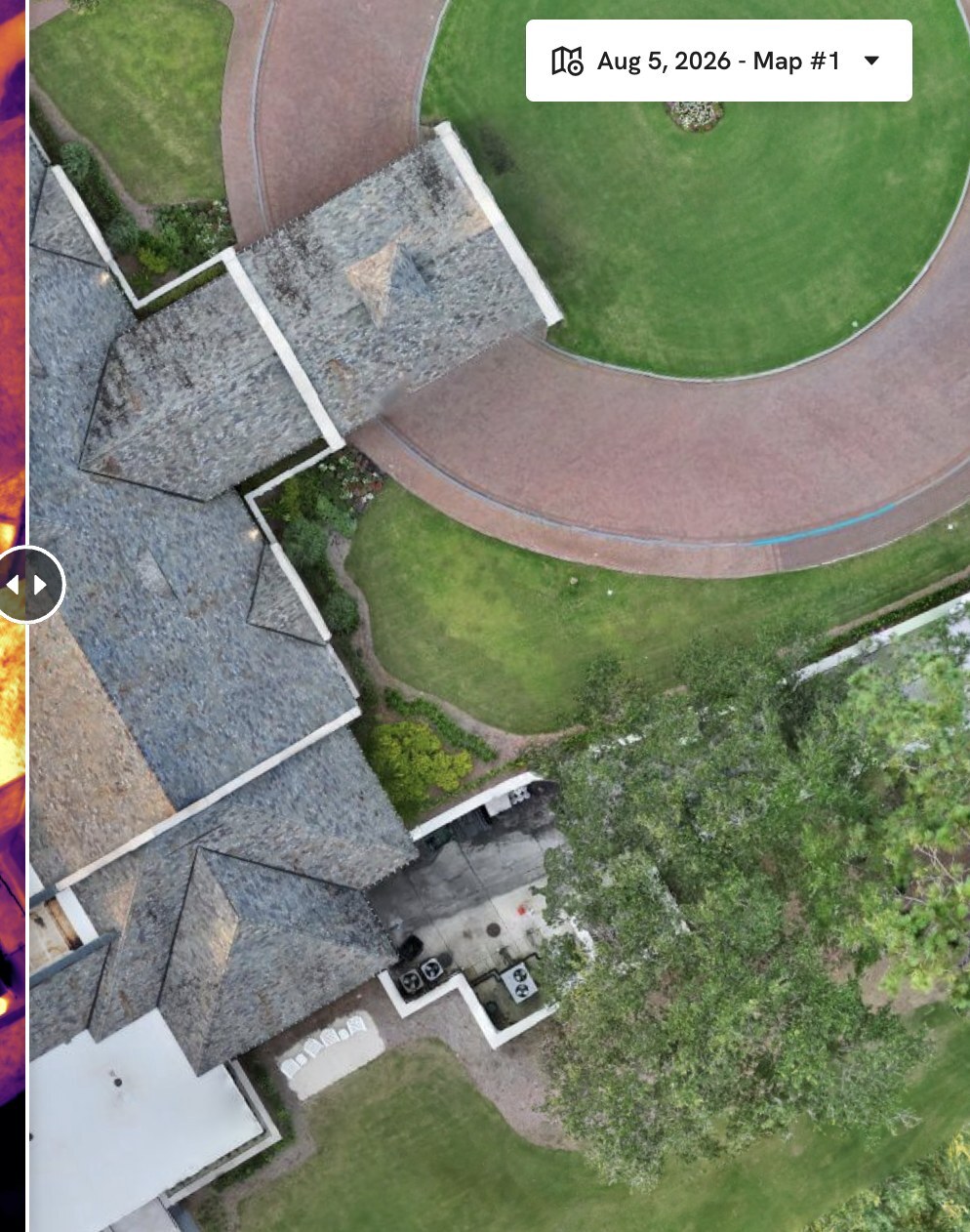
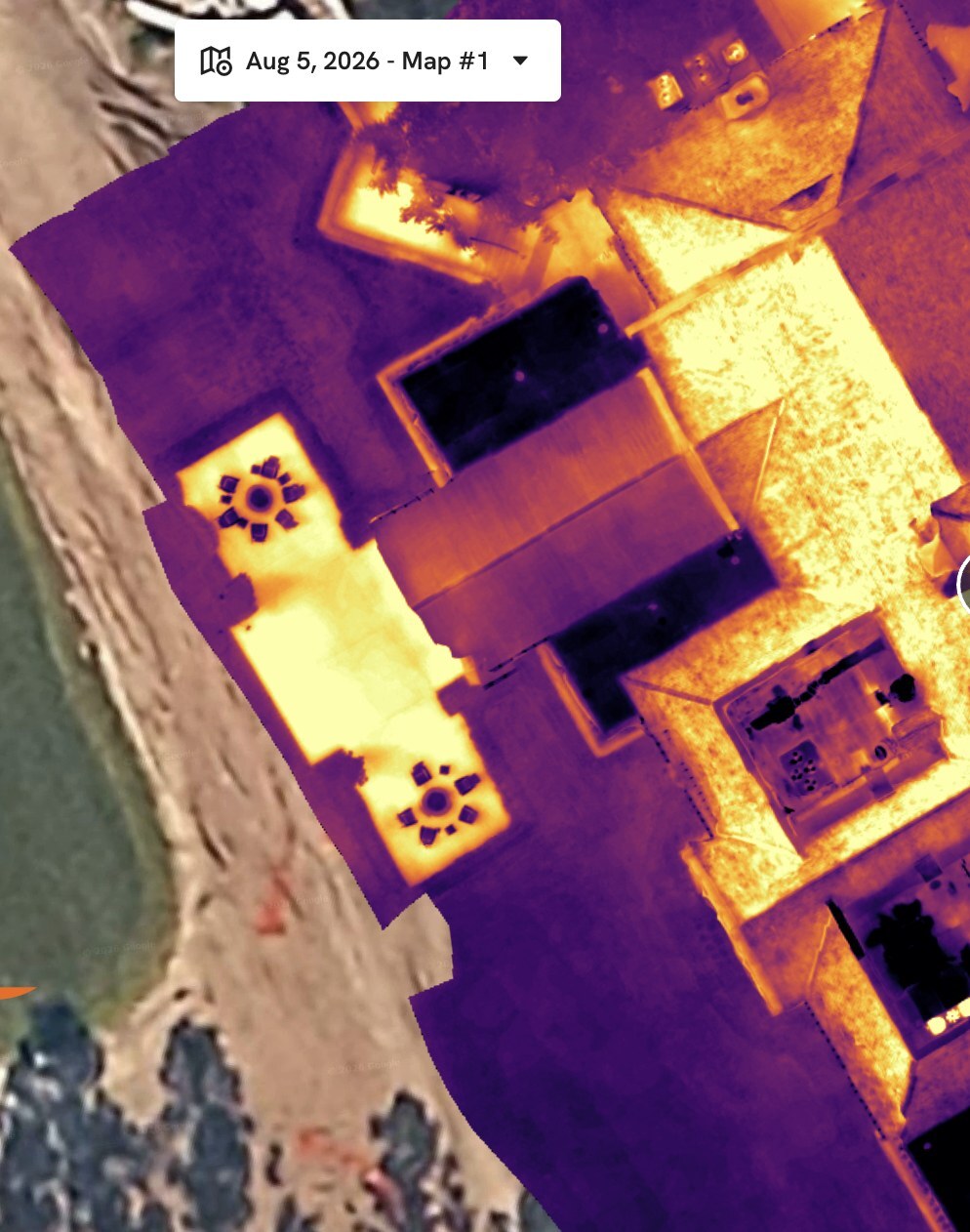
The standard’s output is a map: anomalies delineated and located on a scaled plan of the roof, plus marking on the roof itself where the work will proceed to verification. The deliverable is meant to be something a roofing contractor can act on and an engineer can measure from.
This is where aerial work has a real structural advantage over a handheld walk, and where most aerial work still falls short. Individual thermal stills — even good ones — are not a map. They’re a pile of frames with no shared coordinate frame, which means nobody downstream can measure area, compare cycles, or tie a finding to a location without eyeballing it.
We process the thermal captures into a georeferenced thermal orthomosaic and co-register it with the RGB orthomosaic of the same roof. Positional control is stated rather than implied: ASPRS 2024 Class II accuracy via RTK correction, with ground checkpoints flown to verify the solution instead of assuming it. Every anomaly then carries a coordinate, an area, and a location on the building’s own roof plan.
4. The report has to say what was done, and what it can’t tell you
C1153 expects the write-up to carry the methodology, the equipment used, the conditions at the time of survey, the qualifications behind the interpretation, the findings, and — the part that gets dropped most often — the limitations. Areas that couldn’t be surveyed. Conditions that degraded the imagery. Indications that were flagged but not verified.
Stating limitations is not a hedge. It’s what makes the rest of the document credible. A report with no limitations section is telling you either that the roof was perfect or that nobody was paying attention, and the second is far more likely.
Where C1153 stops and C1060 starts
Worth keeping straight, because vendors blur them. C1153-23 covers infrared location of wet insulation in roofing systems. ASTM C1060-23 covers thermographic inspection of insulation in building envelopes — walls and framed cavities, where the driver is a conditioned-space temperature differential rather than solar loading and nighttime cooling. Different physics, different survey window, different standard. A roof survey cited to C1060 is a tell.
Why any of this matters downstream
A thermal finding rarely stays a thermal finding. It becomes a warranty claim against a roofing manufacturer, a line item in a capital reserve study, a change order, or an exhibit in an insurance file. At every one of those tables the question is the same: how do you know, and can you prove it.
That’s why our missions ship with the standards they were flown under — C1153-23 for the thermal methodology, ASPRS 2024 Class II for positional accuracy, Part 107 for the operation — and full chain of custody on the raw radiometric captures, the processed orthomosaics, and the correction data, retained together and delivered within 48 hours of the flight. Records assembled that way are the kind that satisfy authentication under FRE 901 and 902 if a file ever gets contested. Records assembled after the fact are not.
The takeaway
C1153-23 is not a marketing badge. It is a short list of things that have to be true for infrared roof imagery to mean anything: right conditions, documented; anomalies verified rather than assumed; findings mapped rather than photographed; limitations stated.
Ask any vendor to walk you through those four. The ones running a real survey will do it in about two minutes. The ones selling pictures will change the subject.
If you have a roof, a portfolio, or a scope question that thermal data might answer, schedule a call or request a quote. We’ll scope it honestly and tell you whether we’re the right fit.